Well Decembers here so that means Halloween and Thanksgiving are over and now it’s time for Christmas. And nothing brings back warm memories of the holidays like Christmas music. It fills your heart with joy to snuggle next to a fire with a cup of hot coco and listen to some yuletide rock. Every year a friend of mine makes a holiday mix cd and hands out copies as gifts to friends It’s like, ‘here’s a copy of my favorite Christmas crap,’ Thanks! So this year I made my own list of holiday jingles and have decided to pass the gift along with you, enjoy. You’re welcome!
The Top Ten Christmas Songs
by The Rev James Jones
No.10Bruce Springsteen and the E Street Band “Santa Claus is Comin’ To Town”
Captured live , Springsteen sets the scene on his beloved Jersey Shore: “It’s all cold down along the beach, the winds whipping down the Boardwalk.” Then, he does some interacting with his band mates, checking with Clarence to see if he’s been rehearsing real hard so Santa will bring him a saxophone. And only then does Springsteen sing. No.9The Ramones “Merry Christmas (I Don’t Want to Fight Tonight)”
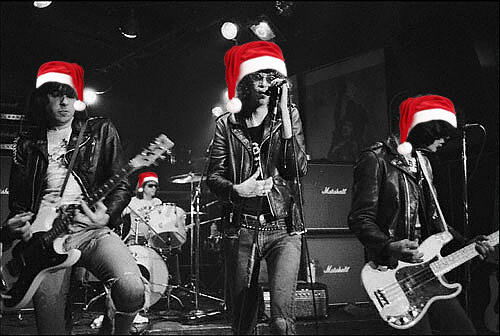
A punk-rock yuletide classic, complete with an opening riff that sounds more like the Sex Pistols channeling Eddie Cochran than the more typical buzzsaw approach the Ramones seemed to favor. It’s Christmas in Queens and poor Joey Ramone is just trying to find himself a little peace on earth. He can’t find Santa, can’t find Rudolph, can’t find Blitzen and his girl can’t find it in her heart to set aside their differences, despite his pleas of “Christmas ain’t the time for breaking’ each other’s hearts.” Phil Spector would have killed to have this for his girls back in the ’60s. Well, not literally killed. No.8Trans-Siberian Orchestra “Christmas Eve/Sarajevo 12/24”
The Trans-Siberian Orchestra recorded this song in honor of cello player who insisted on playing amidst the rubble in war-torn Bosnia as a sign of hope. It’s actually a combination of two songs: God Rest Ye Merry Gentlemen and Carol of the Bells. It’s powerful, it’s beautiful, and it rocks.
No.7Rob Halford “O Holy Night”
O Holy Halford, the Judas Priest frontman brings studs and leather to the holidays as he offers a new version of the old classic ‘O Holy Night.’ Rob Halford’s soaring vocals along with a serious guitar solo is enough to put any metal head in the mood for some present wrapping, tree lighting and egg nog drinking this holiday. No.6The Smashing Pumpkins “Christmastime”
Christmas bring out the softer side in many of us, including the Smashing Pumpkins, who show off their delicate side with this violin and piano driven track ‘Christmastime.’ Billy Corgan’s soft, nasally vocals along with bells and a xylophone create a lullaby feel to the song which is enough to pull on the heart-strings of even the hardest rocker.
No.5Twisted Sister “Deck the Halls”
No one quite celebrates the holidays like Twisted Sister. They have made bringing the Christmas spirit a major priority with their annual Christmas Extravaganza tour, where they play a combination of Twisted Sister classics and rocking renditions of Christmas carols off of their celebrated album ‘A Twisted Christmas.’ Leave it up to Dee Snider to make things a little twisted. No.4Linkin Park “My December”
We slow things down with Linkin Park’s original song ‘My December.’ Frontman Chester Bennington’s tender vocals are beautiful to listen to. The song is a relaxing one to listen to by the fire or after you’ve worn yourself out from moshing with your cousin to ‘White Christmas’ by Guns N’ Roses. Either way, it’s a lovely winter lullaby to unwind to.
No.3Lemmy Kilmister “Run Rudolph Run”
Motorhead frontman Lemmy Kilmister shows his holiday spirit with ‘Run Rundolph Run,’ which was originally popularized by another rebel — Chuck Berry. The 1950s rock ‘n’ roll sound is heard throughout but definitely amped up with heavier riffs and Lemmy’s gritty vocals. Did we mention the song also features Dave Grohl and ZZ Top’s Billy Gibbons? Enough said, Happy Holidays, metal heads! No.2Queen “Thank God It’s Christmas”
Brian May and Roger Taylor give their version of thanks in this Christmas classic to remember. God save the Queen and thanks for Christmas. No.1AC/DC “Mistress For Christmas”
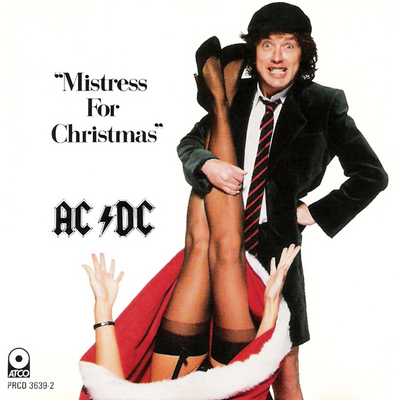
Of course the band that was on the highway to hell had to bring sex into Christmas or the universe just wouldn’t be right. Look, it’s not like Ozzy wouldn’t do it, Brian Johnson just beat him to the punch.
A Holiday Bonus Kathie Lee “it’s Christmas Time”
About what you’d expect from morning TV’s sparkly hostess, right down to the guest appearance of former co-host Regis Philbin on “Silver Bells” Hey, it’s Christmas time you haters, Leave Kathy Lee Alone!
Have a very merry Christmas and remember, if you find Kathy Lee under your tree on Christmas morning, someone really loves you. I mean, this cd is hard to find and they had to have gone to a lot of trouble to get it for you. So smile and give grandma a big hug for the gift, then go get a copy of AC/DC and everything will be o.k.. Jingle ling.
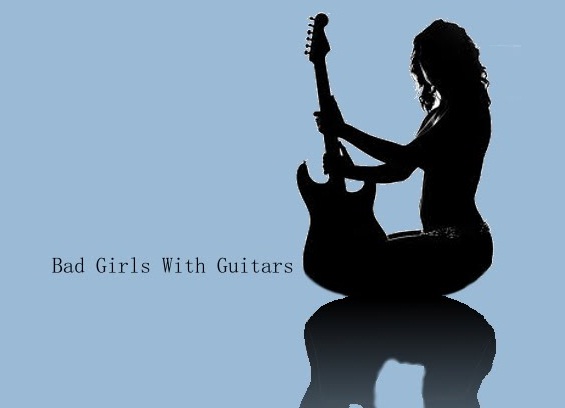
For the best girls you have ever heard play guitar. It’s not that hard, the net is full of girls that play guitar like boys play video games. These girls rock.
Bad Girls With Guitars is about the best of the best. We search the internet for the best female acts yet to be discovered. If you would like a chance at Bad Girls With Guitars then submit a video on our You Tube channel or email it to RevJames@Yahoo.com
The term Goth provokes visions of the 80’s pale face kids in trench coats and black finger nail polish. But today it walks the runways of fashion and has diversified itself into many forms. Rainbow goth, pink goth, glam goth just to name a few, yet punk still exists as a stand alone, enduring time.
Born from the era of punk, itself a passing trend, both have survived and goth has even grown up now. This is the goth we want to meet, what does the term mean today?
Goth, the people. According to Wikipedia,”The Goths (Gothic: *Gut-þiuda, *Gutans; Old Norse: Gutar/Gotar; German: Goten; Latin: Gothi; Greek: Γότθοι, Gótthoi) were an East Germanic tribe two of whose branches, the Visigoths and the Ostrogoths, played an important role in the fall of the Roman Empire and the emergence of Medieval Europe.”
The Goths were a real people in history, not just a subculture that turned into a fashion statement. Goth (Gothiscandza) is a real place left to history.
“One important source is Jordanes’ 6th-century, semi-fictional Getica which describes a migration from southern Scandza (Scandinavia), to Gothiscandza, believed to be the lower Vistula region in modern Pomerania, and from there to the coast of the Black Sea. The Pomeranian Wielbark culture and the Chernyakhov culture northeast of the lower Danube are archaeological traces of this migration. In the 3rd century, either through crossing the lower Danube, or travelling by sea, the Goths ravaged the Balkan Peninsula and Anatolia as far as Cyprus, sacking Athens, Byzantium, and Sparta. By the fourth century, the Goths conquered Dacia, and were divided into at least two distinct groups separated by the Dniester River, the Thervingi, led by the Balti dynasty, and the Greuthungi, led by the Amali dynasty. Centered around their capital at the Dnieper, the Goths ruled a vast area which at its peak under the Kings Ermanaric and Athanaric stretched from the Danube to the Volga river, and from the Black to the Baltic Sea.
In the late fourth century, the Huns invaded the Gothic region from the east. While many Goths were subdued and joined the ranks of the Huns, a group of Goths led by Fritigern fled across the Danube and revolted against the Roman Empire, winning a decisive victory at the Battle of Adrianople. Meanwhile, the Goths were converted from paganism to Arian Christianity by the Gothic missionary Wulfila, who devised the Gothic alphabet to translate the Bible. In the fifth and sixth centuries, the Goths separated into two tribes, the Visigoths, who became federates of the Romans, and the Ostrogoths, who joined the Huns.
After the Ostrogoths successfully revolted against the Huns at the Battle of Nedao in 454, their leader Theodoric the Great settled his people in Italy, founding a Kingdom which eventually gained control of the whole peninsula. Shortly after Theodoric’s death in 526, the country was captured by the Eastern Roman Empire, in a war which caused enormous damage and depopulation to Italy. After their able leader Totila was killed at the Battle of Taginae, effective Ostrogothic resistance ended, and the remaining Goths were assimilated by the Lombards, another Germanic tribe, who invaded Italy and founded a Kingdom in the northern parts of the country in 567 AD.
The Visigoths under Alaric I sacked Rome in 410, defeated Attila at the Battle of the Catalunian Plains in 451, and founded a Kingdom in Aquitaine which was pushed to Hispania by the Franks in 507, converted to Catholicism by the late sixth century, and in the early eighth century conquered by the Muslim Moors. Subsequently, the Visigothic nobleman Pelagius began the Reconquista with his victory at the Battle of Covadonga, and founded the Kingdom of Asturias, which eventually evolved in to modern Spain and northern Portugal.
While its influence continued to be felt in small ways in some west European states, the Gothic language and culture largely disappeared during the Middle Ages. In the 16th century a small remnant of a Gothic dialect known as Crimean Gothic was described as surviving in the Crimea.”
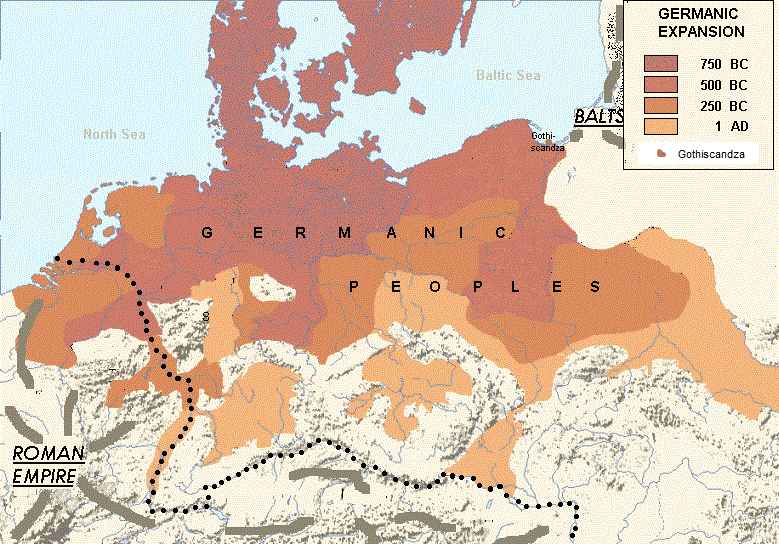
gothiscandza map
Gothiscandza The Place (*)
“According to a tale related by Jordanes, Gothiscandza was the first settlement of the Goths after their migration from Scandinavia (Scandza) during the first half of the 1st century CE.
Jordanes relates that the East Germanic tribe of Goths were led from Scandza by their king Berig. As soon as they had set foot in the land, they named the area Gothiscandza. They soon moved to the settlements of the Rugians (Ulmerugi, a Germanic tribe which had arrived in the area already before the Goths), who lived on the coast, and they chased them away. Then they defeated their new neighbours, the Vandals.
After some time, when at least four generations of kings had passed after Berig, and Filimer was the king of the Goths, their numbers had multiplied. Filimer decided that everyone was to leave Gothiscandza and move to a new region named Oium (Scythia). Several archeologians and historians have proposed the theory that the name Gothiscandza was evolved linguistically into Kashubian and other West Slavic languages’ rendition of the various historical names of Gdańsk (German: Danzig.)”
Gothiscandza, also known for being a guild in Dungeons and Dragons via goths.guildportal.com a virtual world that honors the original one by carrying on it’s name. A world where you can RPG goth.
The birth of Goth.
(*)
“The goth subculture is a contemporary subculture found in many countries. It began in England during the early 1980s in the Gothic rock scene, an offshoot of the post-punk genre. The goth subculture has survived much longer than others of the same era, and has continued to diversify. Its imagery and cultural proclivities indicate influences from the 19th century Gothic literature along with horror films and to a lesser extent the BDSM culture.
The goth subculture has associated tastes in music, aesthetics, and fashion. The music of the goth subculture encompasses a number of different styles including Gothic rock, deathrock, post-punk, darkwave, Industrial, EBM, EDM, Gabber, Ethereal, and neoclassical. Styles of dress within the subculture range from deathrock, punk and Victorian style attire, or combinations of the above, most often with dark attire, makeup and hair.”
Origins and development
“The earliest significant usage of the term (as applied to music) was by Joy Division‘s producer, Tony Wilson on 15 September 1979 in an interview for the BBC TV program’s Something Else : Wilson described Joy Division as “Gothic” compared to the pop mainstream, right before a live performance of the band. In 1979, the Gothic term was later applied to “newer bands such as Bauhaus who had arrived in the wake of Joy Division and Siouxsie and the Banshees“. In 1979, Sounds described Joy Division as “gothic” and “theatrical”. In February 1980, Melody Maker qualified the same band as “masters of this gothic gloom”. Critic Jon Savage would later say that their singer Ian Curtis wrote “the definitive Northern Gothic statement”.
However, it was not until the early 1981 that Gothic rock became its own sub genre within post-punk, and that followers of these bands started to come together as a distinctly recognizable movement. The scene appears to have taken the Gothic name from an article published in UK rock weekly Sounds: “The face of Punk Gothique”, written by Steve Keaton and published in February 1981. In a text about the audience of UK Decay, journalist Steve Keaton asked this question: “Could this be the coming of Punk Gothique? With Bauhaus flying in on similar wings could it be the next big thing?”. In July 1982, the opening of the Batcave in London’s Soho provided a prominent meeting point for the emerging scene, which would be briefly labeled “positive punk” by the NME in a special issue with a front cover in early 1983. The term “Batcaver” was then used to describe old-school goths.
Independent from the British scene, the late 1970s and early 1980s saw death rock branch off from American punk in California.
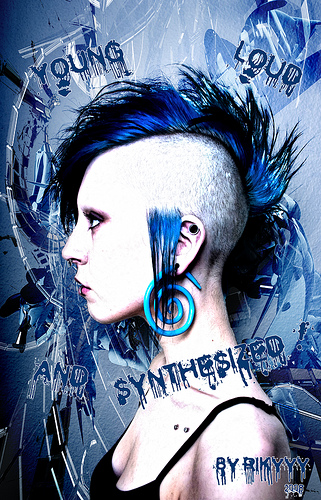
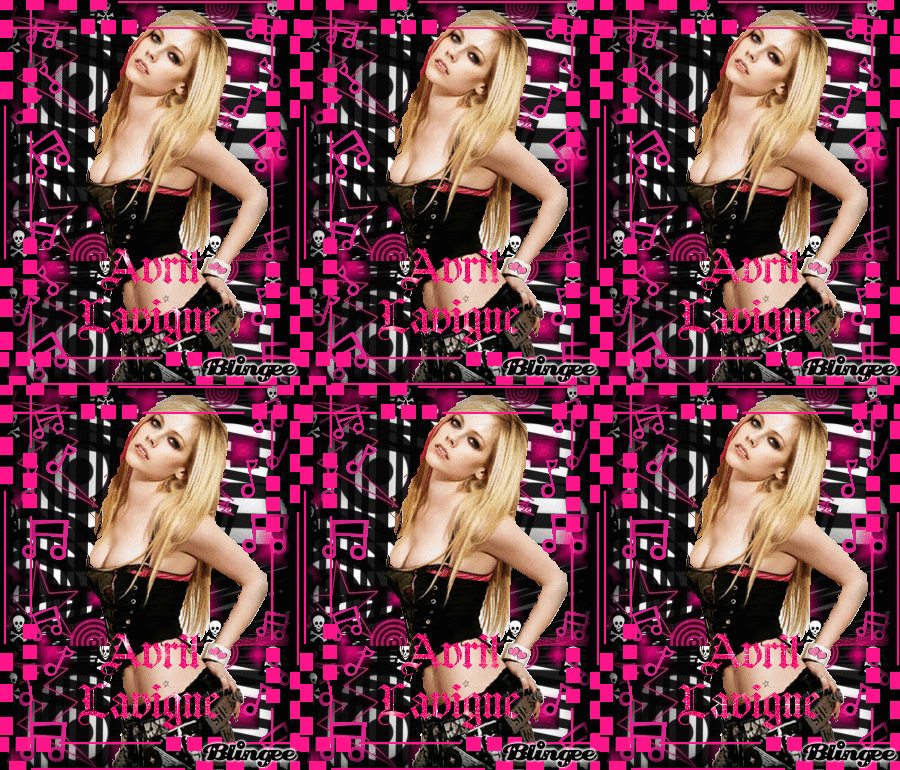
Avril’s Pink Punk
Television and movies
The influence of the Gothic novel on the goth subculture can be seen in numerous examples of the subculture’s poetry and music, though this influence sometimes came second hand, through the popular imagery of horror films and television. The powerful imagery of horror films began in German expressionist cinema after the first world war and then passed onto the Universal Studios films of the twenties and thirties, and then to the horror films of the English Hammer Studio.
By the 1960s, TV series, such as The Addams Family and The Munsters, used these stereotypes for camp comedy. The Byronic hero, in particular, was a key precursor to the male goth image, while Dracula’s iconic portrayal by Bela Lugosi appealed powerfully to early goths. They were attracted by Lugosi’s aura of camp menace, elegance and mystique. Some people credit the band Bauhaus’ first single “Bela Lugosi’s Dead“, released August 1979, with the start of the goth subculture, though many prior art house movements influenced Gothic fashion and style, the illustrations and paintings of Swiss artist, H. R. Giger being one of the earliest. Notable examples of icons would later include several leaders of bands: Siouxsie Sioux of Siouxsie and the Banshees, Robert Smith of The Cure, and Dave Vanian of The Damned. Some members of Bauhaus were, themselves, fine art students or active artists.
Film poster for The Hunger, a key influence in the early days of the goth subculture.
Some of the early Gothic rock and deathrock artists adopted traditional horror film images and drew on horror film soundtracks for inspiration. Their audiences responded by adopting appropriate dress and props. Use of standard horror film props like swirling smoke, rubber bats, and cobwebs featured as Gothic club décor from the beginning in The Batcave. Such references in their music and image were originally tongue-in-cheek, but as time went on, bands and members of the subculture took the connection more seriously. As a result, morbid, supernatural, and occult themes became more noticeably serious in the subculture. The interconnection between horror and goth was highlighted in its early days by The Hunger, a 1983 vampire film, which starred David Bowie, Catherine Deneuve, and Susan Sarandon. The film featured Gothic rock group Bauhaus performing Bela Lugosi’s Dead in a nightclub. Tim Burton created a storybook atmosphere filled with darkness and shadow in some of his films like EdwardScissorhands, Beetlejuice, and Batman”
Quotations by Goths:
“…being Goth, for me, is seeing beauty, and its coming destruction, at the same time. For me…It’s the last dance as the walls are crumbling around you…” Beatgrrl
“[Goth] is the ability to find the art where art seems to be lacking; to find the light in the darkness and embrace it for all its worth…” Jennifer Mason
“When a Goth dies, God laughs.” R.G. Green from the parody web site godhatesgoths.
Cute types of goth by www.blackwaterfall.com, How can anyone thinks these guys can harm anyone, bad goth. blackwaterfall.com shows a large variations of goths in a cute cartoon fashion.
People against Goths
The war on goth. Haters are going to hate and people are driven by many causes. The website godhatesgoths.com is one of the most profound, Blaming the culture for the shooting tragedy at Columbine, Co.
godhatesgoths.com is a Christian based web site aimed at removing the Gothic subculture, deeming it violent and “more dangerous to children than pedophiles” -Rev. R.G.Green and a main contributor in the Columbine school shooting.
Goth.net’s www.goth.net response to the school shooting.
Views that today seem archaic and out dated as goth has grown into mainstream. Like www.gothscene.com a goth dating website. A goth dating website, hum.
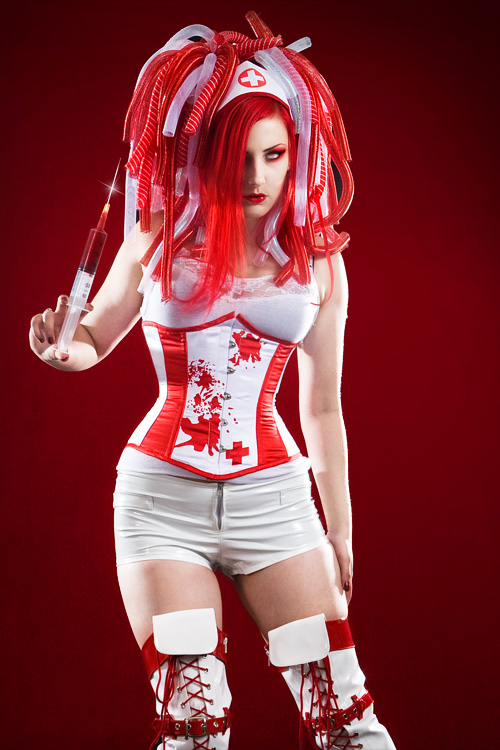
Today’s cyber goth and cyber punk art work that flow across sites like deviantart.com, tumblr, flickr and photobucket are some of the most beautiful works portraying visions of human and technologies future melding. Rainbow Goth, a reverse goth, is filled in rainbows and color. Where fashion embraces the future it had waited for so long. All the way to Pink Punk where little girls bows are ordained with skulls and crossed bones. Thanks to Jack and Sally, small children are well versed in Gothic style. Partially to blame for the zombie apocalypse wars, goth has arrived. Welcome home goth, after almost 33 years, you have survived.














 RevJamesBJones