

Category: Illuminations
10 Logic Commandments
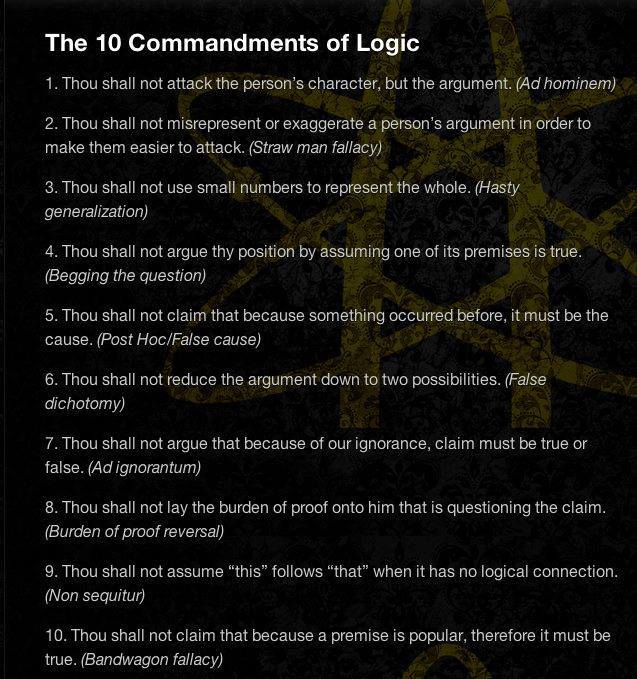
The 10 Commandments of logic
- Thou shall not attack a persons character, but the argument. (ad hominem)
- Thou shall not misrepresent or exaggerate a persons argument in order to make them easier to attack. (straw man fallacy)
- Thou shall not use small numbers to represent the whole. (hasty generalization)
- Thou shall not argue the position by assuming one of it’s premisses is true. (begging the question)
- Thou shall not claim because something occurred before, it must be the cause. (post hoc/false cause)
- Thou shall not reduce the argument down to two positions. (false dichotomy)
- Thou shall not argue that because of our ignorance, claim must be true or false. (ad ignorantum)
- Thou shall not lay the burden of proof onto him that is questioning the claim. (burden of proof reversal)
- Thou shall not assume “this” follows “that” when it has no logical connection. (non sequitur)
- Thou shall not claim that because a premise is popular, therefore it must be true. (bandwagon fallacy)
About Books by Carl Sagan

Carl Sagan’s belief about books
“What an astonishing thing a book is. It’s a flat object made from a tree with flexible parts on which are printed lots of funny dark squiggles. But one glance at it and you’re inside the mind of another person, maybe someone dead for thousands of years. Across the millennia, an author speaking clearly and silently inside your head, directly to you. Writing is perhaps the greatest of human inventions, binding together people who never knew each other, citizens of distant epochs. Books break the shackles of time. A book if proof that humans are capable of working magic.” -Carl Sagan
Commitment

Commitment means staying loyal to what you said you were going to do long after the mood you said it in has left you.
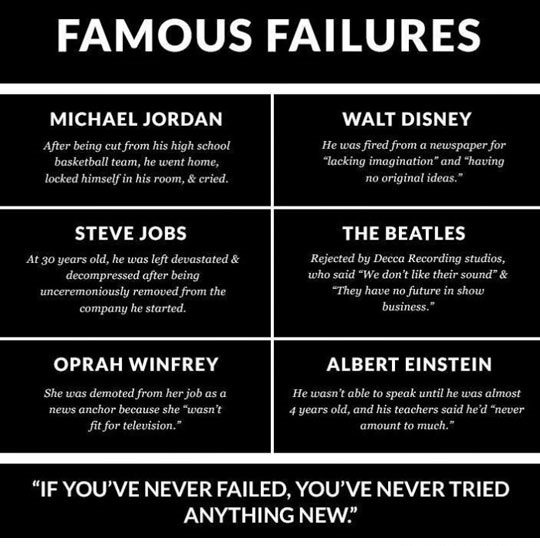
Failure
because you never tried
 RevJamesBJones